

Plenty of SIG owners today started with a striker-fired P320 or P365, but the classic hammer-fired P-series pistols still come across my bench all the time. P226s and P229s show up as retired duty guns, inherited pistols, and range guns that have been shot hard for years. The P220, P224, P225, P227, P229, P239 and P226 share the same owner’s manual from SIG, and they share the same basic design: a mechanically locked, short recoil pistol with an automatic firing pin lock and, on most of them, a decocking lever instead of a manual safety. [1]
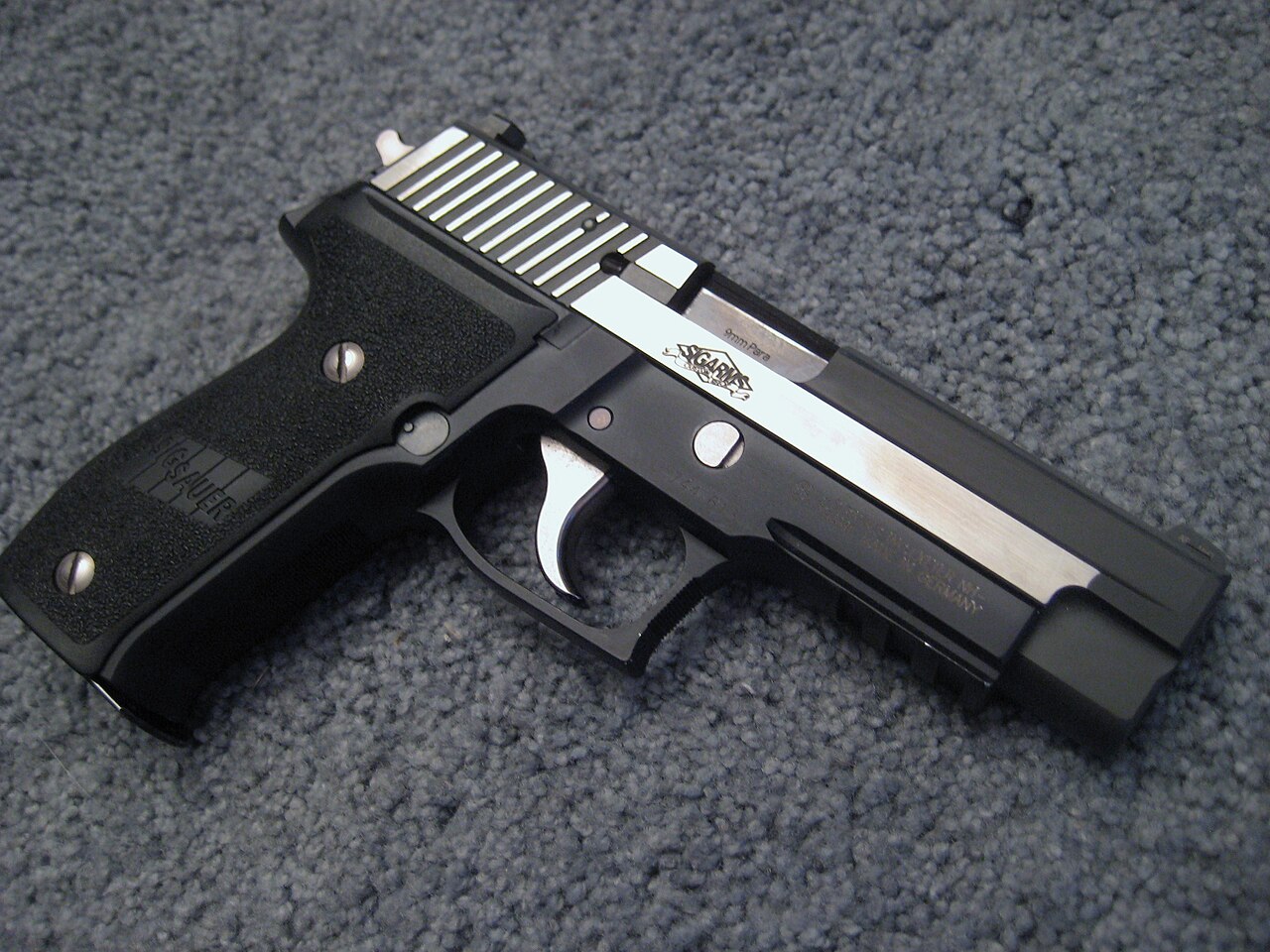

Know Which Trigger System You Have
Before anything else, figure out what you are holding. SIG’s classic manual describes several trigger systems across these models: [1]
- DA/SA (double action/single action): the first shot is a longer, heavier double action pull. After that, the slide cocks the hammer and the following shots are short, light single action pulls. A decocking lever safely lowers the hammer.
- DAO (double action only): the hammer returns to the decocked position after every shot, so every pull is the same. There is no decocking lever.
- DAK (Double Action Kellerman): an improved double action only system with a lighter pull and an alternate intermediate trigger position. No decocking lever.
- SAO (single action only): offered on the P220 category, with an ambidextrous thumb safety instead of a decocker.
A DA/SA P226 and a DAK P226 look nearly identical from across the counter, but they handle differently.
The Decocker Rule: Never Thumb the Hammer Down
If your pistol has a decocking lever, it is the only way you should ever lower a cocked hammer. SIG is blunt about this in the manual: never lower the hammer by pulling the trigger and trying to ease it forward with your thumb. The decocking lever is the only proper means of lowering the hammer and making sure it rests in the safety intercept notch. Keep your finger off the trigger, push the lever down, and let it do its job. [1]
From the bench, I still meet shooters who learned to ride the hammer down on an old revolver or a different pistol and carried that habit over. On a SIG, that habit throws away the safety design built into the pistol. If your thumb slips, there is nothing between that hammer and a live round. Practice the decocker until it is automatic, both at the range and during dry practice with an unloaded pistol.
Cleaning the Classic P-Series
SIG’s manual says malfunctions can largely be avoided by cleaning the pistol after each firing session, whenever you suspect a buildup of firing residue, and whenever the pistol has been exposed to rain, snow, freezing temperatures or other extreme conditions. [1] The newer P226 X-Series manual is even more specific: clean and lube before or after every time the pistol is fired, or at a minimum every 500 rounds. [2]
Field stripping is simple. With the pistol unloaded and the chamber verified empty, lock the slide back, rotate the takedown lever down to the 6 o’clock position, ease the slide forward and off, then remove the recoil spring and guide and the barrel. One note for owners of SRT (Short Reset Trigger) Elite models: SIG adds a step. As the slide reaches its closed position, decock the pistol so the SRT safety lever fully retracts and the slide can come off. [1]
When you clean, follow SIG’s basics: [1][2]
- Clean the barrel from the chamber end, never from the muzzle, and use a brush of the correct caliber rather than a steel wire brush.
- Remove dirt from the frame rails, the inside and outside of the slide, and the recoil spring and guide.
- Lightly lubricate those surfaces, and wipe off any excess. SIG warns against over-lubrication.
- Do not lubricate the firing pin. The X-Series manual warns that it can cause a light strike and a failure to fire.
- Remove lubricant from the bore and chamber before you shoot.
- For all-stainless models such as the P220 ST or P226 ST, SIG recommends TW-25B or a similar lubricant designed for stainless steel.
You will hear people say these pistols like to run wet. My take is that they like to run lubricated, which is not the same as dripping. Dry rails cause problems, but so does a pistol packed with oil that has turned into gritty paste. SIG’s own troubleshooting chart lists a pistol that is fouled or too heavily lubricated as a cause of a slide that will not close easily or completely. [1]
Springs and Wear Parts
The classic owner’s manual does not give a recoil spring replacement interval. The current P226 X-Series manual does: replace the recoil spring (or the recoil spring and buffer spring on XFIVE models) every 5,000 rounds. [2] I use that as a sensible reference point for older P226s and P229s too, especially duty trade-ins where nobody knows the round count. If you cannot tell me when the recoil spring was last changed, it is time.
Keep in mind that SIG’s parts policy says some replacement parts require individual fitting, and that the wrong part or an improper adjustment can create an unsafe condition. [1] Use correct factory parts, and leave fitting and internal work to a qualified gunsmith or to SIG.
Common Problems I See and What They Usually Mean
SIG’s troubleshooting chart lines up well with what comes in for service: [1]
- Slide will not close fully: a fouled or overly oiled pistol, or the wrong ammunition.
- Cases staying in the chamber or jamming in the port: dirt causing short recoil, a weak or limp grip, or low-powered ammunition.
- Hammer falls but the round does not fire: an obstructed firing pin or faulty ammunition.
If the obvious fixes do not solve it, SIG’s answer is that the pistol needs service.
Finish With a Function Check
SIG calls for a function check after repairs and after every cleaning and reassembly. With the pistol unloaded, it covers slide travel and lockup, confirming that the hammer cocks and falls firmly as you press the trigger, the slide catch locking the slide back on an empty magazine, smooth magazine insertion and release, and an inspection of the sights, slide, frame and takedown lever for damage. [1] Follow the steps in your manual rather than doing it from memory.
Safety note: SIG says never to use a firearm or magazine that shows signs of damage or fails a function check. If a pistol ever binds, spits gas or powder, punctures a primer, or just does not sound right when it fires, stop shooting, unload it, and have it examined. Don’t try “one more shot.” [1] SIG’s Safety Center lists current customer service contacts and any active safety notices. [3]
Bring Your Classic SIG to Strikepoint
Whether you just picked up a police trade-in P229 or your P226 has been your range gun for a decade, we can help. At Strikepoint Gunsmithing we will detail strip and clean it, inspect it for wear, replace tired springs with the correct parts, run a full function check, and help you decide whether a problem needs to go back to SIG. See our services, browse more in our Sig Sauer resource center, or contact us to set up an appointment.
Sources:
- SIG SAUER, Owner’s Manual: Handling & Safety Instructions for the P220, P224, P225, P226, P227, P229 and P239 (8501154 Rev. 03): https://www.sigsauer.com/pub/media/sigsauer/resources/SIG_ClassicMiniManual_8501154Rev03_LR.pdf
- SIG SAUER, P226 X-Series Pistols Operator’s Manual (1204401-01 Rev. 01): https://www.sigsauer.com/media/sigsauer/resources/OPERATORS_MANUAL_P226-XSERIES_ENGLISH_1204401-01_REV01_WEB_FILE.pdf
- SIG SAUER, Safety Center: https://www.sigsauer.com/safety-center